The Practical AI Partner Framework: A Disciplined Model for Working with AI
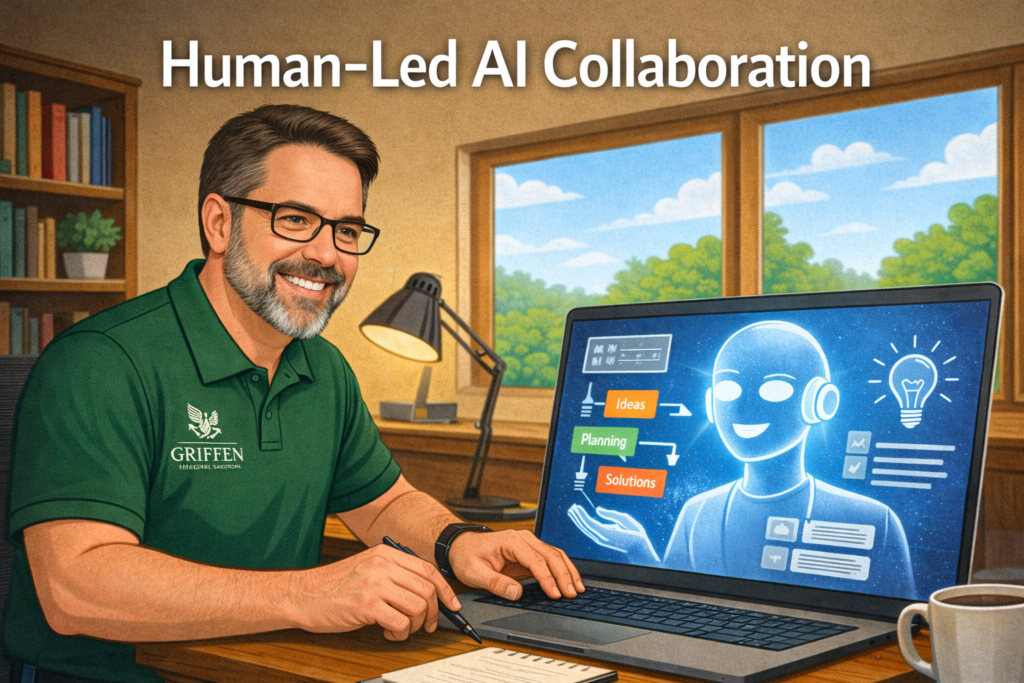
Artificial Intelligence has quickly become part of everyday professional conversations. Leaders, engineers, and operational professionals are increasingly experimenting with these tools to see how they might support their work. Some are enthusiastic about the possibilities. Others remain skeptical. Most fall somewhere in the middle, recognizing that the technology is advancing rapidly but still trying to determine how it should be used responsibly in a professional environment.
One observation I have made over the past year is that many people are using AI in a fairly narrow way. They treat it primarily as a more advanced search engine. A question is entered, an answer is returned, and the interaction ends there. While that approach can occasionally be useful, it captures only a small portion of what the technology is capable of supporting.
The real value of AI is not simply that it can retrieve information quickly. Its greater value lies in its ability to participate in the thinking process. When used appropriately, AI can help professionals explore ideas, test possible approaches, organize complex information, and accelerate the early stages of analysis.
At the same time, it is important to recognize the limitations of these systems. AI does not carry responsibility. It does not understand the organizational context in which decisions are made, and it cannot be held accountable for the outcomes that result from those decisions. Those responsibilities remain with the professionals who are guiding the work.
For that reason, effective use of AI requires more than curiosity. It requires a disciplined approach to collaboration between human professionals and the tools they are using.
This realization led me to develop what I call the Practical AI Partner Framework, a structured model for human-led collaboration with AI.
AI as a Structured Thinking Partner
The most productive way to think about AI is not as a replacement for professional judgment, but as a participant in the thinking process.
When used thoughtfully, AI can assist professionals in several ways. It can help generate alternative ideas when a team is exploring possible solutions. It can assist with organizing complex information into clearer structures. It can provide a starting point for drafting communications, reports, or presentations. It can also help identify questions or perspectives that might otherwise be overlooked during early problem-solving discussions.
In each of these cases, AI is not making the decision. Instead, it is helping to expand the range and speed of the thinking process.
That distinction is important. Professionals in leadership, engineering, operations, and other technical disciplines are ultimately responsible for the decisions that affect their organizations. They are responsible for the consequences of those decisions as well. AI may assist in exploring ideas, but it does not carry professional accountability.
A useful way to view the relationship is that AI can serve as a thinking partner, while the human professional remains responsible for direction, evaluation, and final judgment.
This perspective forms the foundation of the Practical AI Partner Framework.
Why Professionals Benefit from a Framework
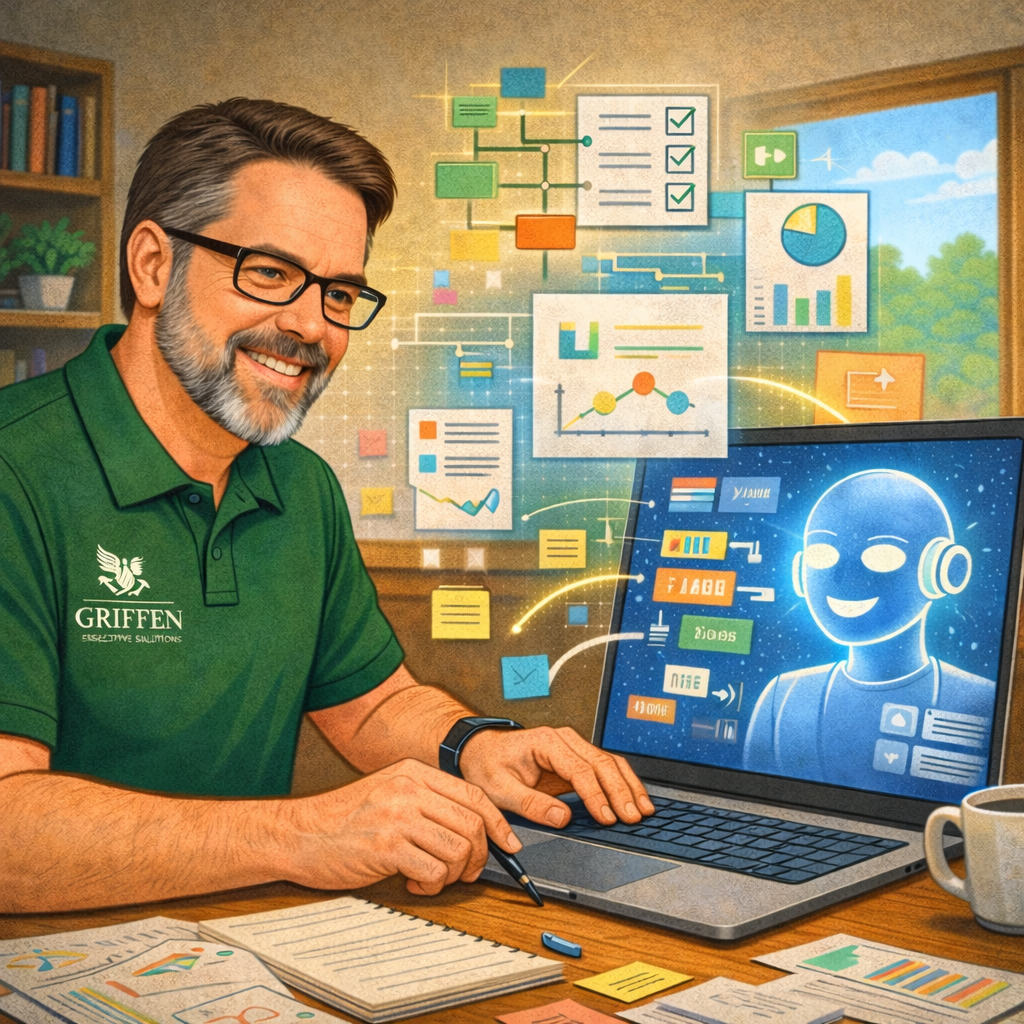
As more people experiment with AI tools, it has become clear that the results vary widely depending on how the tools are used. Some individuals accept the outputs without sufficient scrutiny. Others dismiss them too quickly. In many cases, the interaction with the tool is largely unstructured.
In casual settings that may not create significant problems. In professional environments, however, decisions often affect employees, customers, safety considerations, and organizational performance. Because of this, professionals need a consistent way to guide their interactions with AI.
A framework provides that structure. It reminds us that AI should operate within a professional process that includes clear intent, careful evaluation, and appropriate governance. Rather than relying on ad-hoc experimentation, the framework helps ensure that the collaboration between human and machine remains purposeful and accountable.
The Practical AI Partner Framework
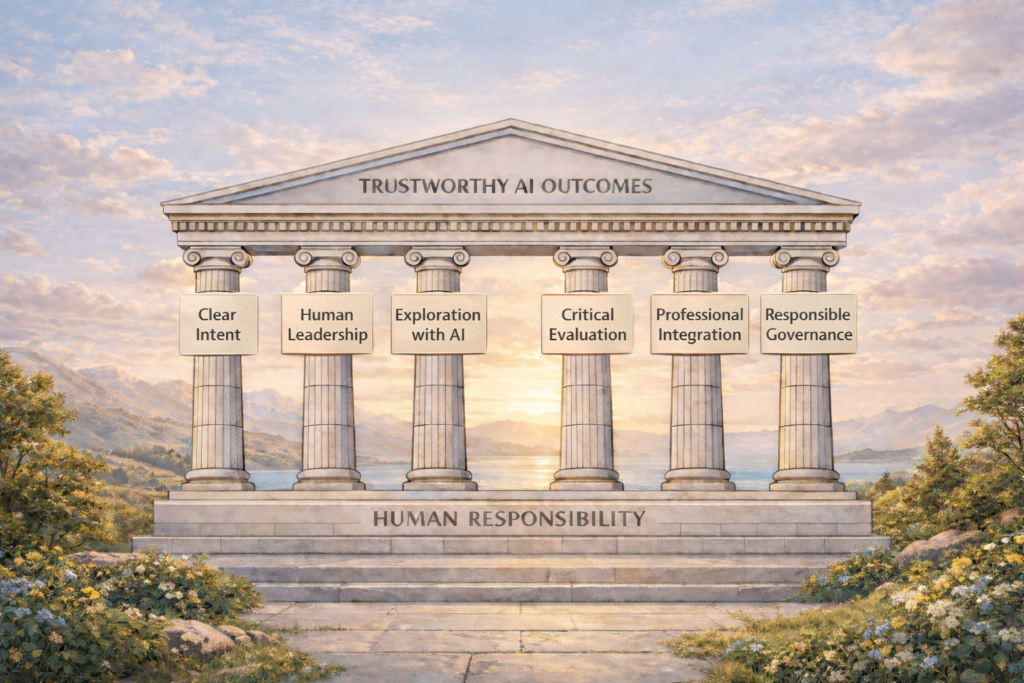
The Practical AI Partner Framework organizes responsible collaboration with AI into three layers: a foundation, six supporting pillars, and an outcome that results when these elements work together.
A Simple Tool to Help You Apply the Framework
To make the framework easier to use in daily work, I have created a short reference sheet that summarizes the structure of the Practical AI Partner Framework.
The tool outlines the foundation of human responsibility, the six pillars of responsible collaboration, and the resulting goal of trustworthy AI outcomes. Many readers find it helpful to keep this type of visual reference nearby when they begin experimenting with AI tools in their professional work.
If you would like a copy, you can download it here:
You may find it useful as a reminder that effective collaboration with AI is not simply about asking better questions. It is about maintaining a disciplined relationship between human leadership and technological capability.
Foundation: Human Responsibility
At the base of the framework is a simple principle. Human professionals remain responsible for the direction of the work, the evaluation of ideas, and the final decisions that are made.
AI may contribute to the exploration of possibilities or the organization of information, but it does not assume ownership of the outcome. Professionals must continue to apply their experience, judgment, and understanding of organizational context.
Maintaining this foundation helps ensure that AI remains a supportive tool rather than an uncontrolled influence on decision-making.
The Six Pillars of Responsible Collaboration
Building on this foundation are six pillars that guide the interaction between human professionals and AI.
Clear Intent
Effective use of AI begins with a clearly defined objective. Before engaging the tool, the professional should understand the question being explored or the problem being addressed. Clear intent helps focus the interaction and improves the relevance of the responses generated.
Human Leadership
AI should operate under human direction. The professional determines the scope of the interaction, guides the exploration, and retains responsibility for how the results are used. The tool supports the process, but it does not replace the leadership of the individual guiding the work.
Exploration with AI
One of the most valuable capabilities of AI is its ability to assist with exploration. It can generate alternative perspectives, propose potential approaches, and help expand the range of possibilities under consideration. This capability can be particularly useful during the early stages of problem solving or strategic planning.
Critical Evaluation
Outputs generated by AI must always be examined carefully. Professionals should verify important facts, question assumptions, and compare the suggestions against their own experience and knowledge. Critical evaluation ensures that the collaboration remains grounded in sound professional judgment.
Professional Integration
Ideas generated through AI interaction must ultimately fit within real organizational environments. Workflows, operational constraints, regulatory considerations, and cultural factors all influence whether an idea can be implemented successfully. Professional integration ensures that insights are adapted to the realities of the organization.
Responsible Governance
Finally, organizations must establish appropriate guidelines for how AI tools are used. Issues such as data protection, confidentiality, ethical considerations, and accountability should be addressed clearly. Responsible governance protects both the organization and the professionals who are working with these tools.
Trustworthy Outcomes
When the foundation and pillars of the framework are respected, AI collaboration becomes significantly more reliable.
The thinking process can move more quickly. Alternative perspectives can be explored more efficiently. Draft ideas can be developed and refined with greater speed.
At the same time, the integrity of the work is preserved because the process remains guided by professional judgment and responsible oversight.
The outcome is not simply faster work. It is work that remains trustworthy because it is still led by accountable professionals.
A Practical Example
Consider a leader preparing for an important strategic discussion.
AI could be used to help outline possible strategic directions, organize background information, or identify potential risks that might deserve attention during the conversation. It might also assist with drafting a preliminary outline of the presentation that will be shared with the leadership team.
Each of these activities can accelerate the preparation process.
However, the leader must still review the information carefully, verify the accuracy of important details, and apply knowledge of the organization’s goals, culture, and operational realities. The final recommendations must reflect the leader’s own judgment and experience.
In this example, AI contributes to the thinking process, but the responsibility for the decision remains clearly with the leader.
The Practical AI Collaboration Cycle
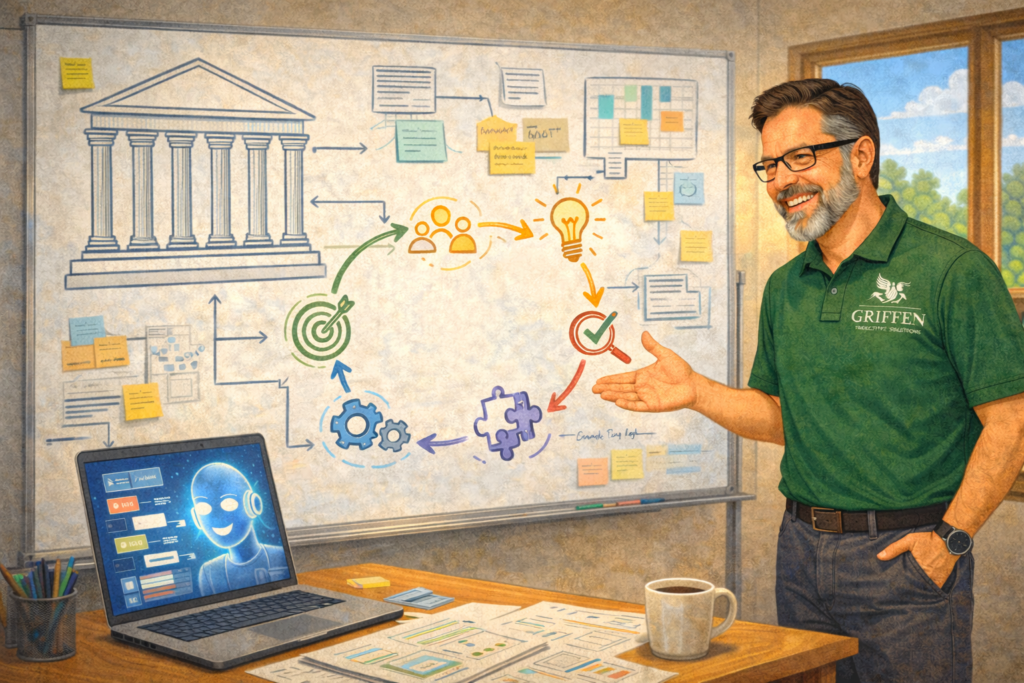
Understanding the framework is important, but the real value comes from how you apply it in practice. Working with AI is not a one-step process where you ask a question and simply accept the answer. Effective collaboration happens through a deliberate cycle of interaction, reflection, and refinement.
This is what I call the Practical AI Collaboration Cycle.
At its core, the cycle reflects a simple truth: AI produces its best work when humans actively guide the process. Rather than treating AI as a vending machine for answers, we engage it as a partner in structured exploration.
The cycle typically unfolds in six stages.

Clear Intent
Every effective interaction starts with clarity. Before opening an AI tool, define what you are trying to accomplish. What problem are you solving? What outcome do you want? Clear intent helps the AI focus on the right direction from the start.
Human Leadership
The human remains responsible for guiding the work. This means setting the context, providing direction, and determining when the output is useful. AI can assist with analysis and generation, but the human must remain the decision-maker.
Exploration with AI
This is where the collaborative work begins. You pose questions, test ideas, explore alternatives, and examine possibilities. AI can expand thinking, surface patterns, and suggest directions that may not have been obvious.
Critical Evaluation
Not every output from AI should be accepted at face value. This stage involves reviewing results carefully, checking assumptions, and ensuring the response aligns with reality, ethics, and professional standards.
Professional Integration
Once an output has been evaluated, it must be integrated into real work. This could mean refining a strategy, improving a document, adjusting a plan, or incorporating the insight into a broader decision-making process.
Responsible Governance
Finally, every use of AI should reflect thoughtful oversight. Leaders must consider accountability, transparency, and the impact of decisions made with AI support.
After governance and reflection, the cycle naturally begins again. New questions emerge, insights deepen, and the collaboration continues.
This continuous loop is what transforms AI from a novelty into a reliable professional partner.
Why I Wrote The Practical AI Partner
Over the past year I have spent considerable time exploring how AI tools can support professional work. In my consulting and coaching practice, as well as in my own writing, I have had many opportunities to experiment with these systems and observe how others are using them.
What became clear fairly quickly was that many professionals were interested in the potential of AI but lacked practical guidance for using it responsibly. Much of the available information focused either on the technical development of AI systems or on broad predictions about the future.
Far less attention was given to a more immediate question: how should professionals actually work with AI today in a disciplined and accountable way?
That question led me to write The Practical AI Partner: A Professional Guide to Human-Led, Accountable AI Collaboration. The book explores the principles of responsible AI collaboration and provides practical approaches that professionals can apply in their day-to-day work.
If you are interested in exploring the full model in greater depth, The Practical AI Partner: A Professional Guide to Human-Led, Accountable AI Collaboration provides a structured guide to responsible AI collaboration, including practical methods, examples, and governance considerations for professionals working in real organizations.
You can learn more about the book or purchase a copy here: Griffen Executive Solutions LLC
The framework described here represents the central idea behind that approach.
Beginning with a Simple Principle
For professionals who are beginning to explore AI, the starting point does not need to be complex. It begins with a clear understanding of the relationship between human leadership and technological capability.
AI can assist in exploring ideas and accelerating aspects of the thinking process. At the same time, professionals remain responsible for evaluating the results and determining how those ideas should be applied.
When that balance is maintained, AI can become a valuable partner in professional work.
The technology may continue to evolve rapidly, but the principle remains steady: the quality of the outcome will always depend on the quality of the human leadership guiding the collaboration.