Clarity Before Output: The Missing System Behind Consistent Execution

When Execution Feels Inconsistent
In January, we focused on alignment. Establishing direction is foundational because teams cannot execute what has not been clearly defined. In February, we emphasized rhythm. Even well-aligned organizations struggle if execution lacks cadence and structure. When these two elements are present, most leaders reasonably expect consistency to follow.
By the beginning of Q2, however, another issue often becomes visible. Work is moving. Meetings are occurring. Delegation is taking place. In many organizations, AI tools are assisting with drafting, analysis, and documentation. Yet despite this activity, outputs feel uneven. Projects require revision. Clarifying conversations multiply. Decisions take longer than expected because the material presented does not fully support the choice that needs to be made.
When this pattern appears, the instinct is often to examine effort. Are people fully engaged? Is the team overloaded? Is technology underperforming? In many cases, the issue is not effort. It is clarity at the point of output.
Where Execution Breaks Down

Execution rarely fails because leaders lack intention. Objectives are typically communicated. Teams understand the broad direction. The difficulty tends to emerge later, when intention must be translated into specific work.
Consider how work actually flows within an organization. A leader delegates a task to a supervisor. A cross-functional partner is asked to prepare an analysis. An analyst is requested to summarize performance. An AI system is prompted to draft or synthesize information. In each case, someone or something is being asked to produce output in response to a request.
The work that returns is often reasonable. It may be thoughtful and well constructed. Yet it does not fully serve the decision that needs to be made or the outcome that was intended. Additional clarification follows. Revisions are requested. Time is spent refining the output so that it aligns more precisely with the original objective. In hindsight, it becomes clear that certain elements could have been defined more explicitly at the outset.
When inconsistent execution is examined closely, the common factor is rarely motivation. It is under defining the request.
The Structural Cause: Underdefined Requests
In many instances of rework or misalignment, the original request did not clearly define several critical elements. The purpose of the work may have been assumed rather than stated. The intended audience may not have been specified. The decision or action that depends on the output may have been left implicit. Constraints such as format, scope, or level of detail may not have been articulated. Most importantly, the definition of “good” may never have been described.
In the absence of these elements, recipients make reasonable assumptions. A supervisor relies on prior experience. A peer interprets based on urgency and context. An AI system generates output based on patterns in language and probability. None of these responses are inherently flawed. They are operating with incomplete parameters.
AI makes this dynamic more visible. It does not create ambiguity; it reflects it. When a prompt is vague, the output mirrors that vagueness. When constraints are undefined, variation increases. The same principle applies when delegating to people, but the feedback cycle may be slower and less explicit.
If consistent execution is the objective, the handoff between intention and output must be strengthened.
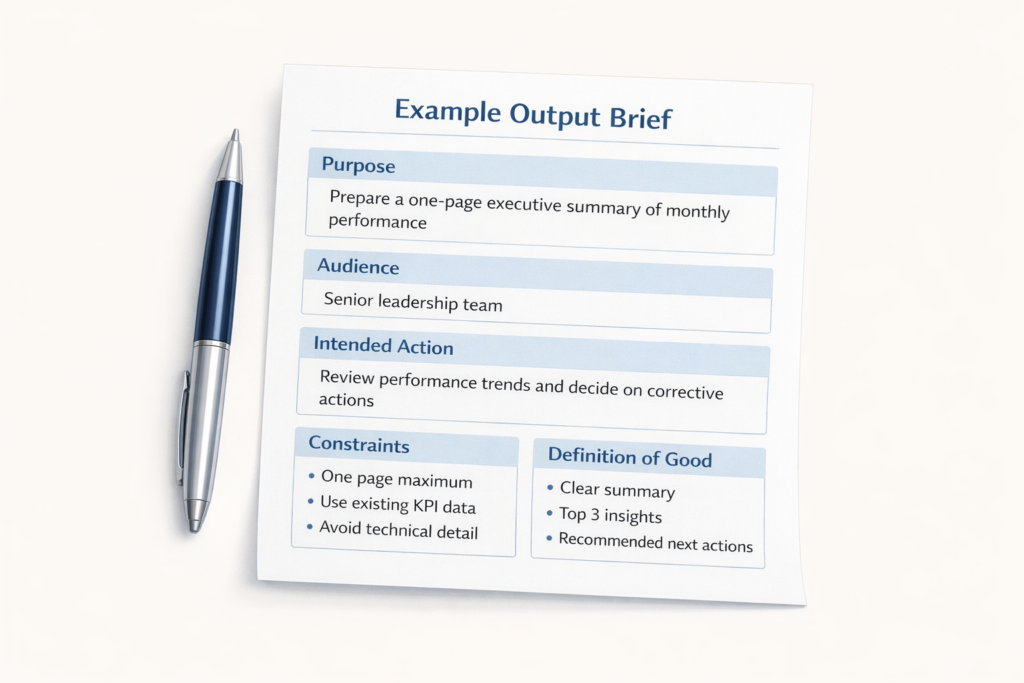
Introducing the Output Brief Framework
To address this issue, I recommend a simple discipline before requesting work from any channel. I refer to it as the Output Brief Framework.
The framework consists of five elements:
- Purpose – Why does this work exist?
- Audience – Who is it for?
- Intended Action – What decision or next step depends on it?
- Constraints – What boundaries apply, such as time, format, tone, or scope?
- Definition of Good – What would make you say the output is complete and usable?

This framework is not intended to introduce bureaucracy. In most cases, these elements can be defined in a few sentences. The objective is not documentation for its own sake, but clarity before output. The same structure applies whether the request is directed to a supervisor, a cross-functional partner, a vendor, or an AI system.
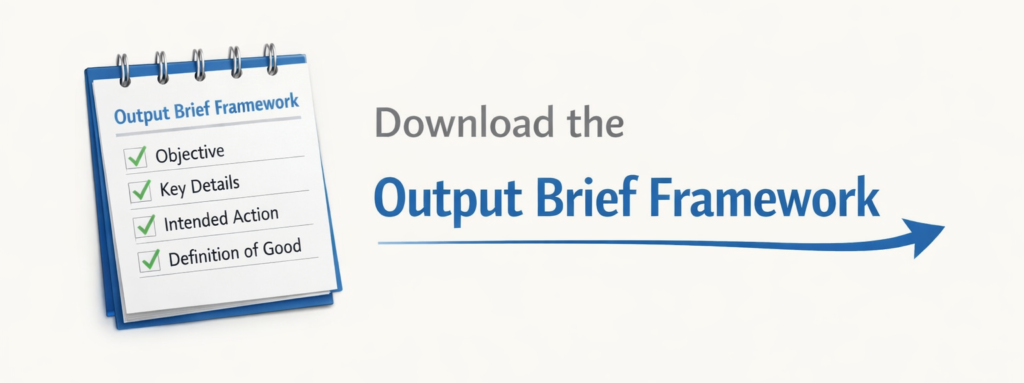
To make this practical, I have developed a downloadable worksheet titled The Output Brief Framework. It provides a structured format for applying these five elements to real work in your organization, including a comparison exercise that demonstrates how clearer briefs improve both delegated and AI-generated output. You can download it and begin using it immediately as you read.
A Leadership Example
Consider a familiar request: “Please prepare a summary of our Q1 performance.” On the surface, this appears clear. In practice, several variables remain undefined. Is the summary intended for internal discussion or board presentation? Is the focus operational performance, financial variance, or strategic positioning? What decision will be made based on the summary? How concise should it be?

Applying the Output Brief Framework brings structure to the request. The purpose might be to prepare for executive review. The audience might be the CEO and CFO. The intended action could be to determine whether to maintain the current hiring plan. Constraints might include a two-page maximum, executive tone, and emphasis on material variances. The definition of good might specify a clear narrative with three key insights and two recommended actions.
With this level of clarity, the likelihood of rework decreases significantly. The recipient understands not only what to produce, but why it matters and how it will be used. The same structure improves output whether the first draft is written by a supervisor or generated with AI assistance.
An Operational Example
The same principle applies in manufacturing and operational environments. A manager might instruct a team member to document the changeover process. Without further clarification, the result may be a list of steps without context. The purpose could range from training to audit compliance to cross-shift standardization. The audience may be unclear. The expected outcome may vary.
Using the framework clarifies intent. The purpose might be to standardize changeover across three shifts in order to reduce time variability. The audience might be line supervisors and new operators. The intended action could be enabling consistent execution without additional verbal explanation. Constraints might include visual steps, one page per major phase, and plain language. The definition of good might be that an operator can follow the document independently and achieve the target changeover time.
Whether a process engineer drafts this documentation or AI assists in structuring it, the clarity of the brief stabilizes the outcome. The difference is not primarily skill or technology. It is definition.
Why This Discipline Matters Now
As organizations become more distributed and technology-enabled, the number of output channels continues to increase. Work flows through hybrid teams. Communication spans functions and locations. AI systems are increasingly integrated into drafting, analysis, and planning workflows.
In this environment, clarity becomes a stabilizing mechanism rather than a preference. The more channels through which work flows, the more important it becomes to define expectations explicitly.
In The Practical AI Partner, I explore this transmission discipline more deeply in the context of working intentionally with AI. The Output Brief Framework presented here is one foundational element of that broader operating model. However, the principle itself extends well beyond technology. Consistent execution requires clarity before output, regardless of the channel through which that output is produced.
If you would like to explore the full operating model behind this approach, you can learn more about The Practical AI Partner here: www.griffenexecsolutions.com/shop/.
Designing for Consistency
Over the past three months, we have examined alignment, rhythm, and now clarity. These are not independent ideas. They are complementary components of execution design.
Alignment establishes direction. Rhythm establishes pace. Clarity stabilizes the handoff between intention and output.

When clarity is absent, rhythm simply accelerates inconsistency. When alignment is present but the handoff is weak, even capable teams produce uneven results. Conversely, when the Output Brief Framework becomes habitual, execution begins to feel less fragile. Fewer cycles are spent correcting misunderstandings. Decisions are supported by work that was designed to inform them. AI becomes more useful because it is operating within defined parameters rather than inferred assumptions.
If execution has felt inconsistent despite clear goals and steady effort, the issue may not be commitment. It may be definition.
Consistent execution is not the product of pressure. It is the result of deliberate design. Strengthening the handoff is a practical place to begin. If you would like to implement this approach immediately, download The Output Brief Framework and apply it to one meaningful request this week. Even a small improvement in clarity can produce measurable improvements in output.