Avoiding the Year-End Crunch: Smarter Project Management for Q4
The air turns crisp, calendars fill up, and suddenly every conversation seems to start with, “We just need to get this done before year-end.”
For leaders and project managers in the manufacturing and equipment world, the fourth quarter is a familiar mix of urgency and exhaustion — finalizing customer projects, closing financials, wrapping up capital spending, and trying to prepare for next year, all while teams are running on fumes.
It’s no wonder Q4 often feels like a mad dash. But the truth is, the year-end crunch isn’t inevitable. It’s the product of too many priorities competing for too little focus.
You don’t need to work harder to finish strong — you need to work smarter. The principles of effective project management can turn a chaotic sprint into a controlled glide. Let’s look at three practical ways to bring structure, focus, and calm to the close of your year.
1. Prioritize Ruthlessly — Not Everything Has to Finish This Year
One of the most common traps in Q4 is the assumption that every open project must be wrapped up by December 31. In reality, only a subset of projects are truly critical to close out. The rest can (and often should) roll into the new year.
Start by creating a clear distinction between:
- Must Finish Projects: Deliverables tied to financial close, customer contracts, or regulatory commitments.
- Should Finish Projects: High-value work that keeps momentum but isn’t business-critical for year-end.
- Can Wait Projects: Long-term initiatives or internal improvements that can safely resume in Q1 without significant impact.
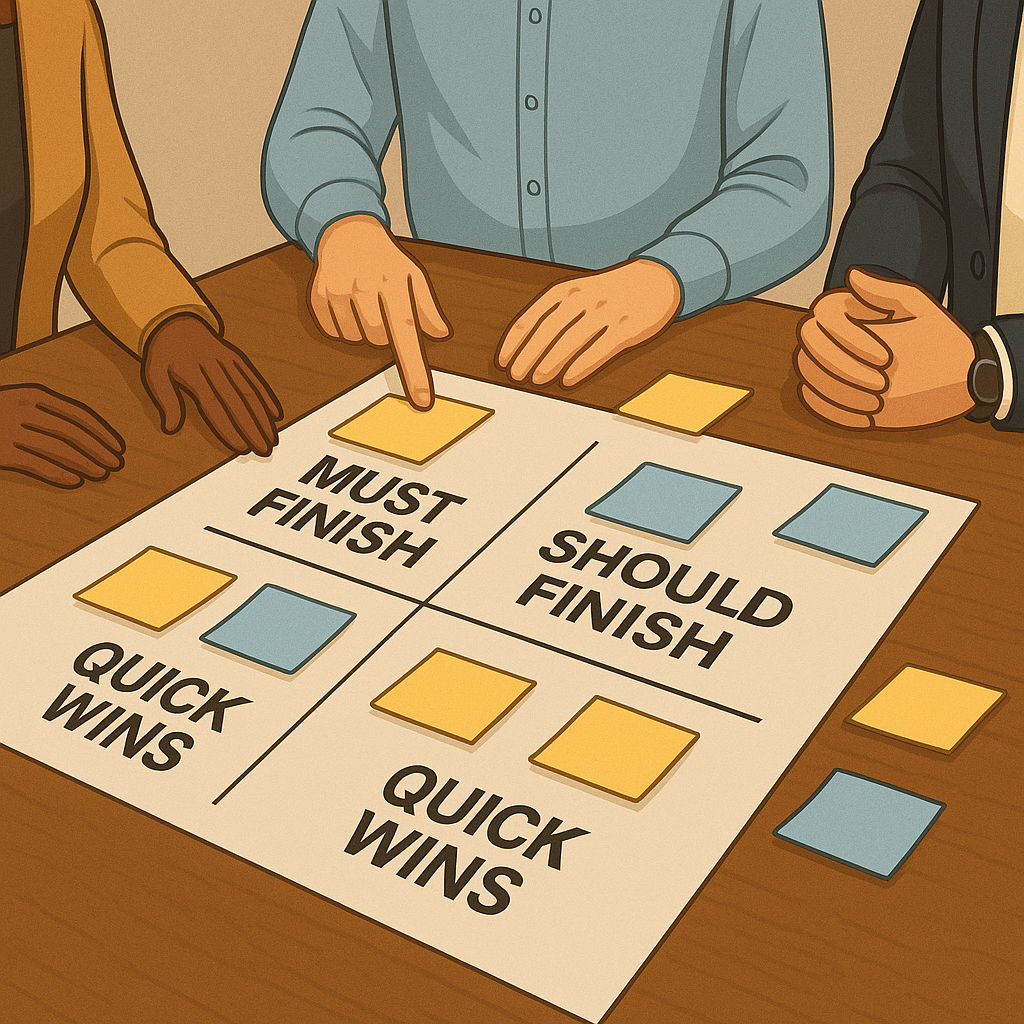
This exercise does more than just create order. It aligns resources with what actually drives results — and it gives your team permission to stop chasing everything at once.
Example:
One of my clients, a mid-sized OEM, had 14 open customer projects entering November. After mapping them in a simple prioritization matrix, they realized that only six were “must finish” to meet contractual obligations. By shifting two engineers to focus exclusively on those six, they met every critical deadline — and reduced overtime hours by nearly 40%. The remaining projects restarted cleanly in January, without customer complaints or lost revenue.
Tool Spotlight:
To help with this, I’ve developed a Q4 Project Prioritization Matrix — a quick visual tool that lets you plot projects by urgency and impact. Once you see the whole portfolio laid out, decisions become clearer, and resource allocation becomes a conversation based on facts, not pressure.
2. Communicate Proactively — Silence Breeds Surprises
In the final stretch of the year, communication often slips. Teams assume everyone knows the plan; leaders assume projects are progressing; customers assume deadlines are on track. Then, somewhere around mid-December, assumptions collide — and panic follows.
The fix is simple but powerful: over-communicate early and often.
- With Customers: Be upfront about what will be delivered by year-end and what will continue in January. Framing it as a “planned continuation” (rather than a delay) builds confidence. Most clients appreciate transparency — it helps them plan, too.
- With Internal Teams: Keep everyone aligned on shifting priorities. A five-minute daily check-in can save five hours of rework later.
- With Leadership: Give your executives and stakeholders clear, concise updates that highlight achievements, risks, and tradeoffs. When people see that you’re managing intentionally, they’re less likely to add new last-minute demands.
Example:
For another one of my clients with projects across multiple plants, we annually do a “Q4 Realignment Brief” in early October. It lists every open project, current status, and expected finish. Executives could see immediately what would close this year and what would roll over. It replaced countless status meetings — and, more importantly, prevented year-end surprises.
Proactive communication isn’t just a courtesy; it’s a form of risk mitigation. It protects trust, prevents panic, and keeps your team from becoming the default “firefighters” for everyone else’s lack of planning.
3. Protect Your Team from Burnout — Efficiency Is Not Endurance
As the calendar winds down, it’s tempting to ask everyone to “just push a little harder.” But Q4 isn’t a sprint — it’s the last mile of a marathon. The energy you save now determines how ready your team will be to start strong in January.
Recognize the signs: declining morale, growing mistakes, or an increase in “we’ll fix it later” attitudes. These are symptoms of fatigue, not failure.
Smart leaders use the final quarter to fine-tune performance rather than push limits.
- Rebalance workloads: Shift tasks from overloaded individuals to those with capacity.
- Tighten meetings: Replace hour-long updates with focused 15-minute huddles.
- Celebrate micro-wins: Every milestone met should be acknowledged, even if the project isn’t complete yet. Recognition is renewable energy.
- Encourage recovery: Protect vacation schedules and model reasonable hours yourself.
Example:
One equipment supplier I coached instituted a “no evening emails” policy during Q4. At first, leaders worried it would slow progress. Instead, it forced teams to prioritize better during the day — and morale jumped almost immediately. Productivity didn’t drop; burnout did.
When people feel valued and supported, they give you their best. And in Q4, your people are your most valuable resource.
A Smarter Way to Finish Strong
October is a natural inflection point — the moment to shift from frantic activity to intentional execution. The leaders who finish the year well aren’t the ones who push the hardest; they’re the ones who plan the best.
By prioritizing ruthlessly, communicating proactively, and protecting your team from burnout, you’ll not only end the year stronger — you’ll start the next one with momentum, clarity, and credibility.
These are the same principles I teach in my Project Management Essentials for Machine Builders course — a hands-on, two-day program that equips teams to manage projects efficiently, communicate clearly, and deliver reliably in the real-world environment of packaging and processing equipment manufacturing.
If your organization is feeling the Q4 squeeze — too many projects, not enough time, and growing client pressure — it’s not too late to change course. Reach out, and let’s talk about how to bring smarter project management to your team.
Finish this year with control, not chaos. And start the next one ready to lead from a position of strength.