The Hidden Friction Tax: Why Good Teams Still Move Slowly
Many organizations do not have a talent problem, a commitment problem, or even a strategy problem. They have a friction problem.
I have seen this pattern many times over the course of my career. Leaders assemble capable teams, define reasonable objectives, invest in systems, and communicate expectations. The people involved are generally intelligent, hardworking, and well-intentioned. Yet progress still feels slower than it should. Projects take longer than expected. Decisions seem to require too many cycles. Teams remain busy, but meaningful movement is less visible than leadership had hoped.
When this occurs, the natural instinct is often to focus on people. We ask whether priorities are clear enough, whether accountability is strong enough, or whether employees are sufficiently engaged. Those are fair questions. However, they are not always the right questions.
In many cases, the real issue is friction embedded within the normal flow of work.
This month, I would like to explore what I call the Hidden Friction Tax, the cumulative cost created by unnecessary resistance inside otherwise capable organizations. I will also offer a practical way to begin identifying and reducing that friction without launching another large initiative.
What Organizational Friction Actually Is
Friction is not usually dramatic or easy to spot. It rarely presents itself as a single crisis. More often, it appears in ordinary daily activity.
It may be an approval process that requires too many touches. It may be unclear ownership of recurring tasks. It may be meetings that continue because they have always existed, even though their value has diminished. It may be work that must be redone because expectations were not fully defined at the beginning. It may be time lost searching for information that should be readily available.
Each individual instance may seem minor. That is part of what makes friction difficult to address. Leaders can look at any one example and reasonably conclude that it is not a significant concern. Yet organizations do not experience friction one instance at a time. They experience it cumulatively.
A ten-minute delay repeated across dozens of people becomes substantial. A weekly meeting with limited value becomes meaningful cost when multiplied across a year. A slow handoff between departments becomes a recurring constraint on throughput. Small inefficiencies, when repeated consistently, become strategic issues.
That cumulative burden is what I mean by the Hidden Friction Tax.
Why Good Teams Often Carry It the Longest
One of the more interesting realities of friction is that strong teams can conceal it for quite some time.
Capable people compensate. Experienced employees know who to call when the formal process fails. Reliable managers absorb ambiguity and personally keep matters moving. Dedicated teams work around weak systems because they care about outcomes.
From the outside, this can create the impression that everything is functioning adequately.
However, compensation has a cost. Time and energy that should be directed toward improvement, innovation, customers, or strategic priorities is instead spent overcoming avoidable obstacles. Over time, leaders may notice fatigue, slower execution, reduced discretionary effort, or frustration that seems difficult to explain.
The explanation is often that good people have been carrying poor systems longer than they should have needed to.
Five Common Sources of Friction
While every organization has its own context, friction tends to emerge in a few predictable places.
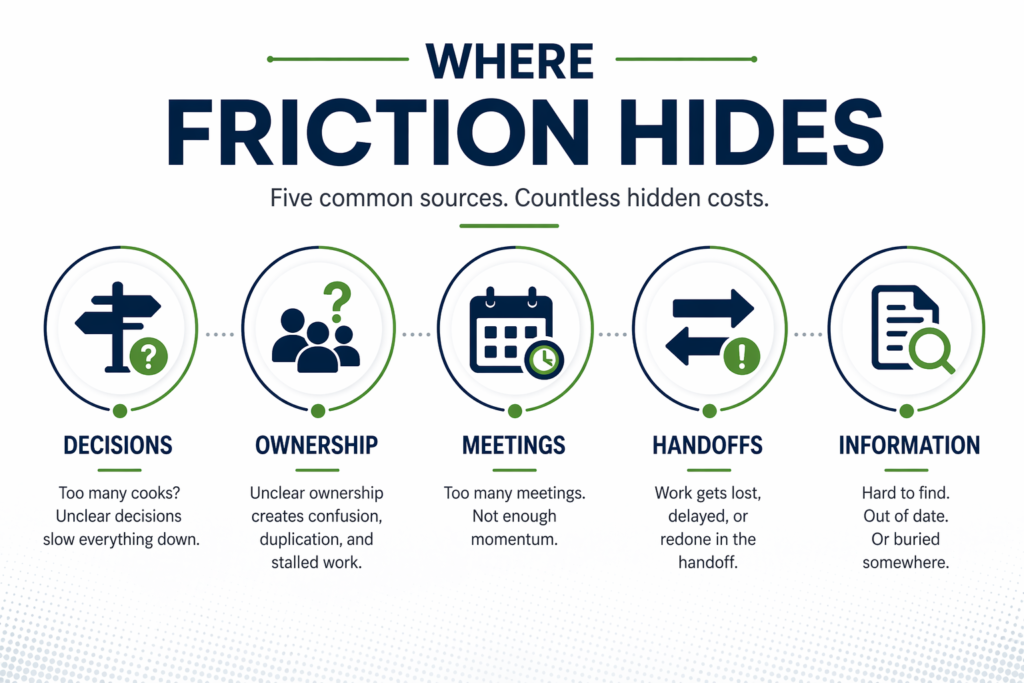
1. Decision Flow
Some decisions require careful review. Others do not.
Organizations slow themselves when routine decisions are escalated unnecessarily, when authority levels are unclear, or when too many people are included in matters that need a clear owner rather than broad consensus.
When decision pathways are inefficient, teams wait. Momentum declines. Attention shifts elsewhere.
2. Ownership Clarity
Many delays occur because responsibility is shared in theory but owned by no one in practice.
This often sounds collaborative, but it creates confusion. Work pauses while people determine who should act next. Follow-up becomes necessary simply to identify ownership.
Healthy collaboration and clear accountability are not opposing ideas. In most cases, accountability improves collaboration because everyone understands their role.
3. Meeting Load
Meetings are valuable when they create alignment, resolve issues, or enable timely decisions. They become friction when they persist without sufficient purpose.
Common examples include recurring meetings with little agenda discipline, update meetings that could have been written, or gatherings with too many participants and too few outcomes.
Many organizations underestimate the cost of meeting load because the time is dispersed across calendars rather than appearing on a financial statement.
4. Weak Handoffs
Work frequently slows at the points where responsibility transfers from one person or function to another.
Examples include sales to operations, engineering to production, supervisor to technician, or one shift to the next. If expectations are unclear, information incomplete, or readiness assumed rather than confirmed, delays and rework become more likely.
As discussed in last month’s blog, clarity at the handoff matters greatly. Friction often increases where clarity decreases.
5. Information Access
People should not need excessive effort to locate routine information required to do their jobs well.
When teams spend time searching for documents, prior decisions, current versions, customer data, or performance metrics, organizations pay a tax that is rarely measured directly but often felt operationally.
Why Leaders Misread the Symptoms
The symptoms of friction are easy to confuse with other issues.
Slow progress may be interpreted as low urgency. Rework may be seen as carelessness. Delays may be attributed to workload alone. Fatigue may be assumed to reflect staffing levels.
Those explanations are sometimes correct. However, leaders should be cautious about assigning people-based explanations to system-based problems.
If the underlying issue is friction, increasing pressure will not solve it for long. It may temporarily accelerate movement, but it often does so by asking people to work harder around the same barriers.
A better response is to examine the barriers themselves.
The Cost of the Hidden Friction Tax
The cost of friction is broader than missed deadlines.
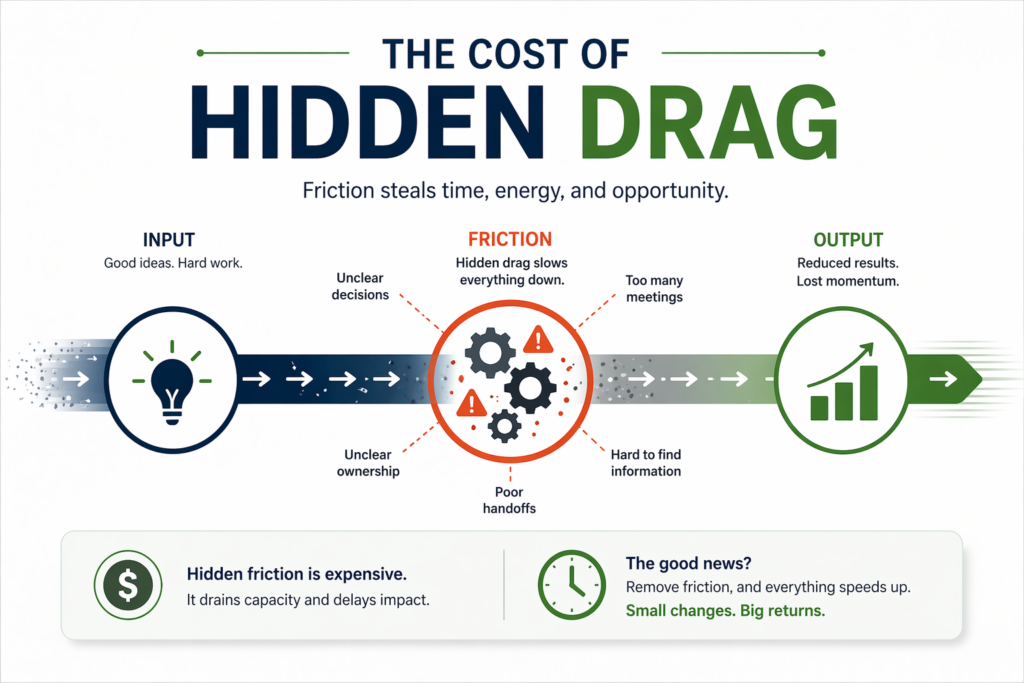
It often includes:
- slower execution of priorities
- unnecessary rework
- excessive coordination effort
- decision fatigue among leaders
- reduced responsiveness to customers
- lower morale among high performers
- less time available for improvement work
- avoidable strain on managers and supervisors
These costs are significant because they affect both performance and culture.
When employees feel that ordinary work requires unnecessary struggle, frustration rises. When leaders feel that everything takes longer than it should, confidence in the organization’s ability to execute can begin to erode.
A Practical Starting Point
Reducing friction does not require a major reorganization. In many cases, it begins with disciplined observation.
Select one important process, recurring workflow, or current initiative and ask the following questions:
- Where do we wait more than we should?
Look for approval delays, scheduling gaps, or decisions that sit idle.
- Where is ownership unclear?
Identify tasks where follow-up is needed simply to determine responsibility.
- Which meetings create limited value?
Be candid about recurring commitments that continue more from habit than necessity.
- Where do handoffs create repeated confusion?
Examine transitions between people, departments, or shifts.
- What information is harder to find than it should be?
Notice where teams repeatedly search for routine knowledge.
Even one honest review can reveal opportunities for improvement.
Remove One Source of Drag
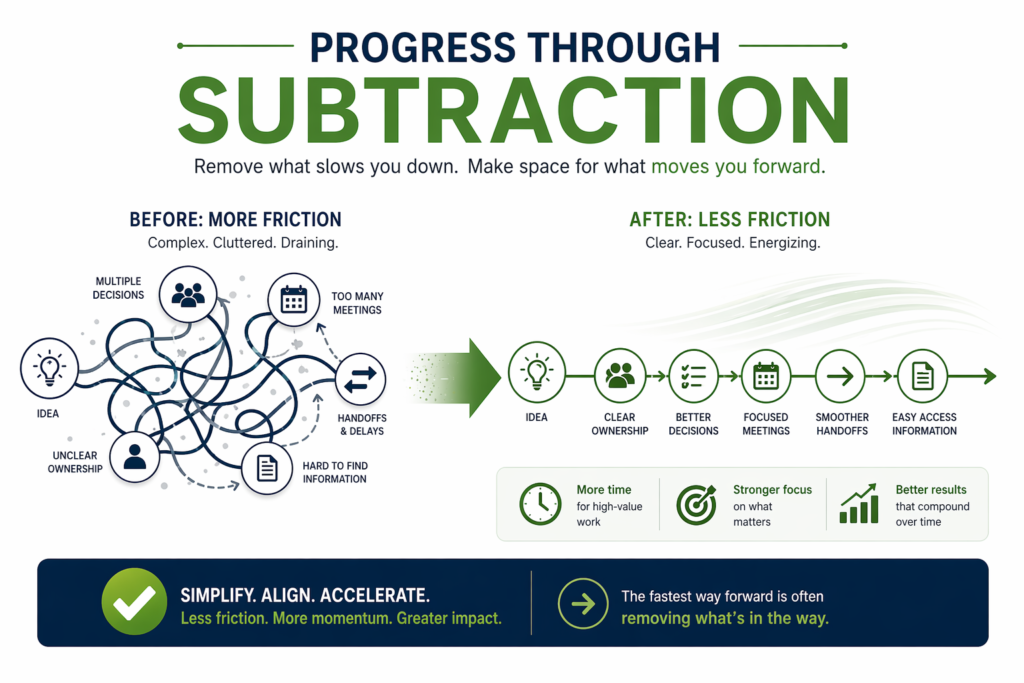
Many organizations pursue progress primarily through addition. They add tools, reports, meetings, controls, or initiatives.
Sometimes the faster path is subtraction.
Remove one meeting that no longer justifies its cost. Clarify one recurring ownership gap. Simplify one approval step. Improve one handoff. Establish one reliable source of truth for frequently needed information.
These are not glamorous changes, but they are often powerful ones.
A Leadership Reflection
Senior leaders do not always hear where friction lives. Employees may have adapted to it. Managers may assume it cannot be changed. Strong performers may quietly compensate rather than complain.
For that reason, leaders should periodically ask:
- What feels more difficult than it should?
- Where do capable people spend time overcoming preventable issues?
- What frustrations have become accepted as normal?
- Where is progress slower than the talent involved would suggest?
These questions can be highly revealing.
Closing Thoughts
We often think of growth as adding capability: more people, more technology, more investment, more activity.
There is truth in that view. However, another path to growth is often overlooked.
Sometimes meaningful progress comes not from adding more energy to the system, but from removing unnecessary resistance within it.
Good teams do not always need more pressure. Quite often, they need cleaner pathways to perform at the level they are already capable of reaching.
To support that effort, I have created the Friction Audit Workbook, a practical tool to help leaders identify hidden drag, prioritize opportunities, and take one meaningful improvement step over the next 30 days.
You may find that the next level of performance is not farther away than you thought. It may already exist beneath the friction that has quietly accumulated over time.